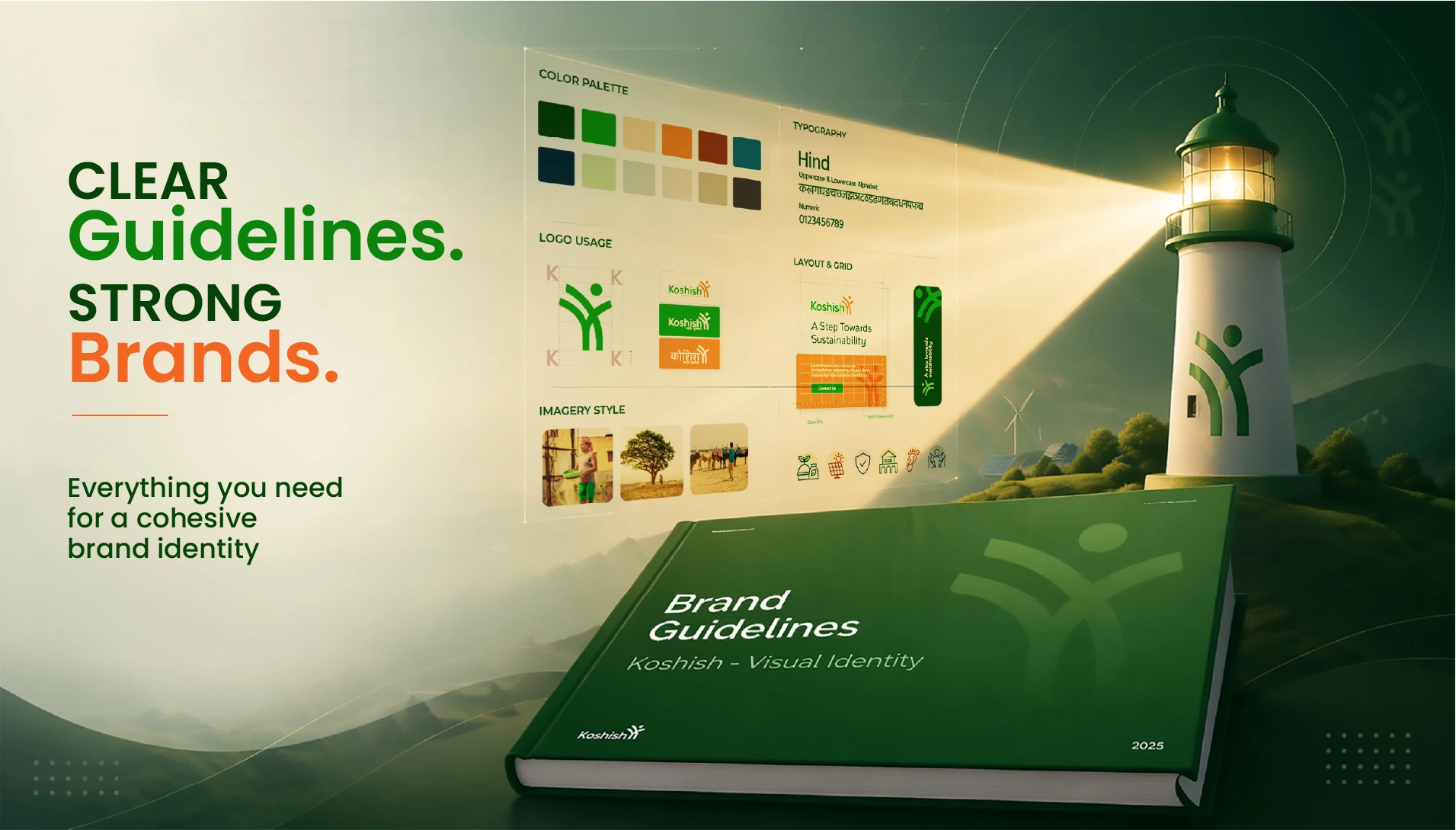
What Are Brand Guidelines?
Brand guidelines are a set of rules that establish how a business should be represented visually, verbally and in written form across platforms and channels.
These rules clearly define how your brand elements (such as logos, colours, typography, voice, content, etc.) should be used by internal teams and external partners.
Beyond this, these guidelines specifically outline the standards that must be followed and the practices that must be avoided, so that brand integrity stays intact.
02 — The Importance"Brand guidelines keep your brand from drifting, guiding all teams with clear direction."
DN Designs
Why Are Brand Guidelines Important?


Let's dive deeper and understand the importance of brand guidelines.
Maintains a Consistent Brand Identity Across Platforms
Inconsistencies can lead to major familiarity and credibility issues for your brand.
Businesses must convey the same identity, values and messaging across platforms and channels, be it packaging design, website, social media, advertising campaigns and marketing materials.
However, each of these platforms and channels is unique, with its own set of requirements. Brand guidelines ensure that you easily adapt your brand assets across platforms without losing your core brand identity.
Strengthens Brand Recognition and Trust
When a brand presents itself consistently everywhere, customers begin to recognise it. They associate the unique colours, typography, imagery, messaging and communication style with the brand. This boosts brand recognition. Over time, this repeated exposure to brand elements builds brand trust and loyalty.
Improves Efficiency Across Teams
You have multiple people and teams working for your brand - designers, social media marketers and writers who all work individually to promote your brand. In the absence of clear instructions, they might end up interpreting and presenting your brand differently. This leads to an inconsistent and confused brand.
Guidelines ensure that your team members have clear rules and frameworks ready before they begin their work. Designers refer to brand guidelines and instantly know which logo variant, colour and typography to use. Marketers also know exactly how to communicate with the customers. This not only simplifies the entire work but also accelerates it - unnecessary mistakes and revisions are avoided, and efficiency is improved.
Supports Business Growth and Expansion
Your business is bound to grow with time. It will launch new products, enter new markets and target new customer bases. Branding becomes more complex - new product packaging designs are created, fresh marketing campaigns are launched, and communication strategies are planned out. Without clearly defined brand guidelines, all these can soon lose direction, clarity and order.
Brand guidelines serve as a foundation for this growth and expansion. It ensures that this growth happens without diluting the core identity and values of the company.
Protects the Brand Identity as It Grows
As your brand grows, more people come into the picture - external agencies, freelancers, vendors, marketing and production teams and more. The issue of misrepresentation of brand identity and inconsistency can once again hamper your brand growth.
Strategic brand guidelines ensure this inconsistent and inaccurate brand representation never happens. It provides a clear set of rules that external partners and collaborators can follow for their communication. So, no matter the number of collaborators, your brand identity stays intact.
Need Help Building Your Brand Guidelines From Scratch?
Talk to ExpertsWhat Do Brand Guidelines Include?
How to Create Brand Guidelines
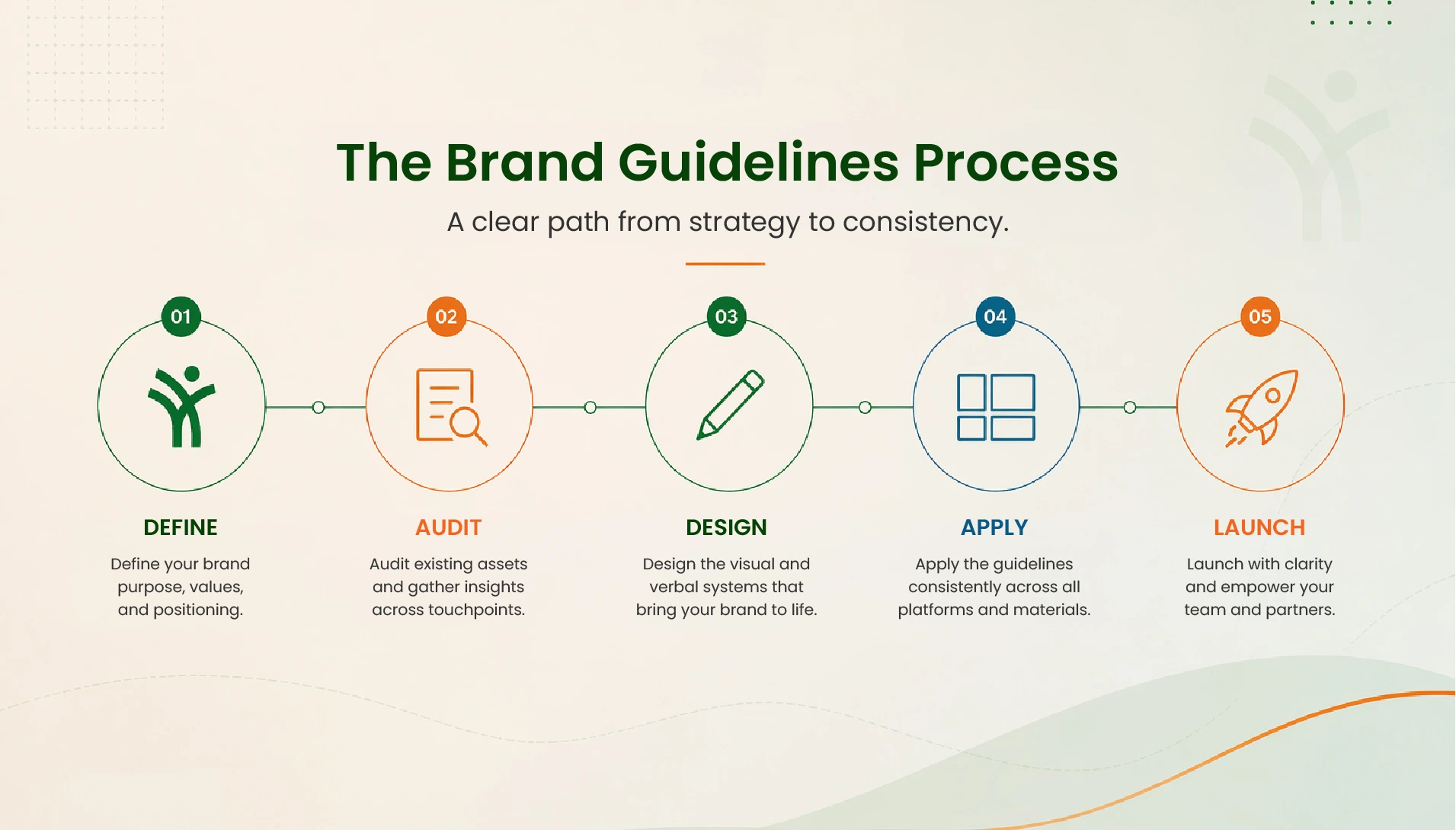
Creating effective brand guidelines is a structured, collaborative process. Here is how it works step by step.
Best Practices for Creating Brand Guidelines
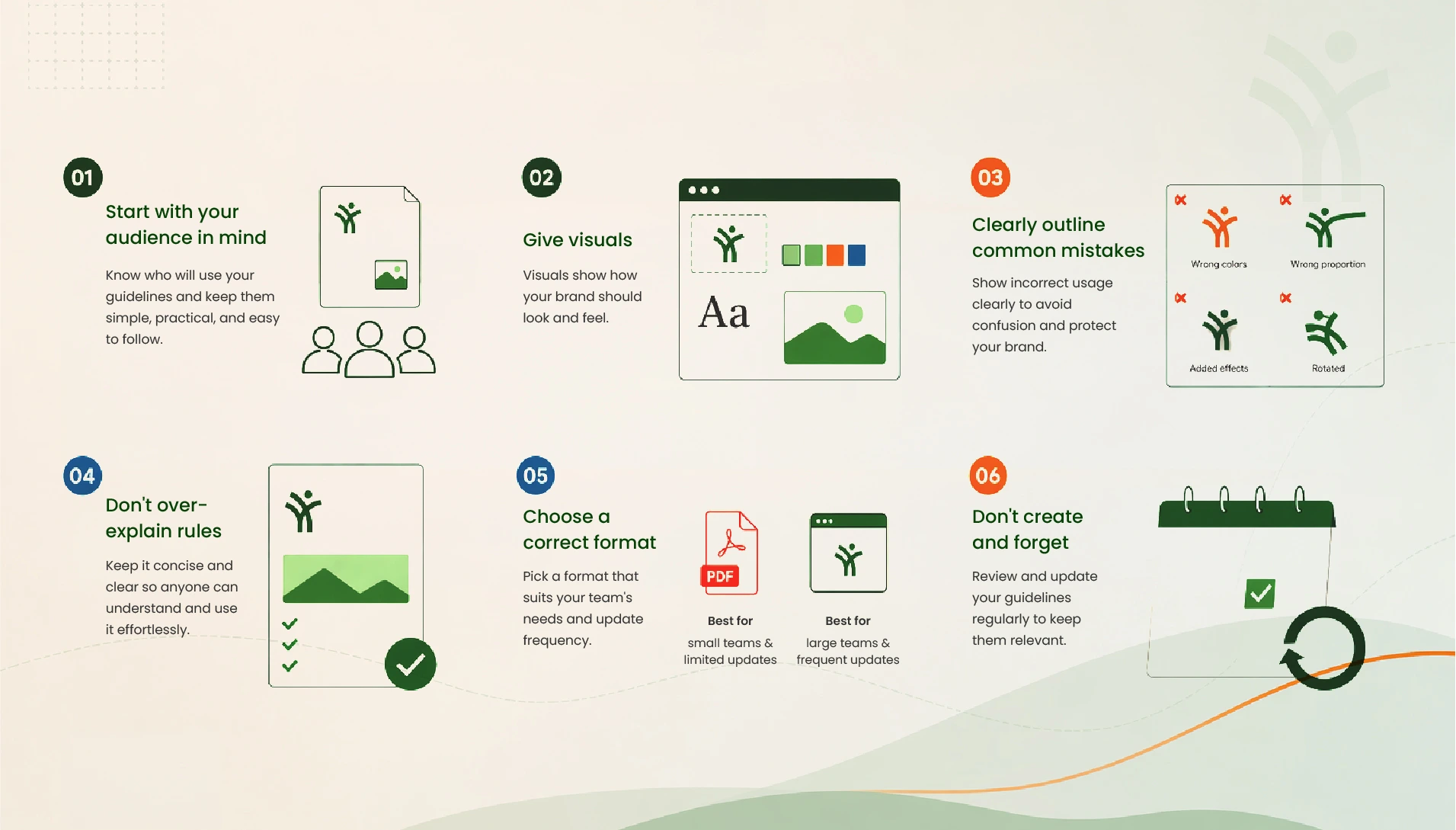
Here are a few quick tips that can make your brand guidelines more effective.
How Often Should Brand Guidelines Be Updated?
The work is not over once you complete the brand guidelines and share them with the relevant people and team. These guidelines need to evolve as the brand grows and diversifies.
Regular reviews can reveal whether the guidelines are being used or not. In case the guidelines are difficult to understand or follow, an update can help fix the issues.
Also, new product launch, expansion into a new market, and a change in brand positioning and target audience may call for revisions and updates in brand guidelines. Rebranding or switching to a new, modern brand identity may also prompt a revision of brand guidelines.
07 — Format ChoicePrint vs PDF vs Digital Brand Guidelines
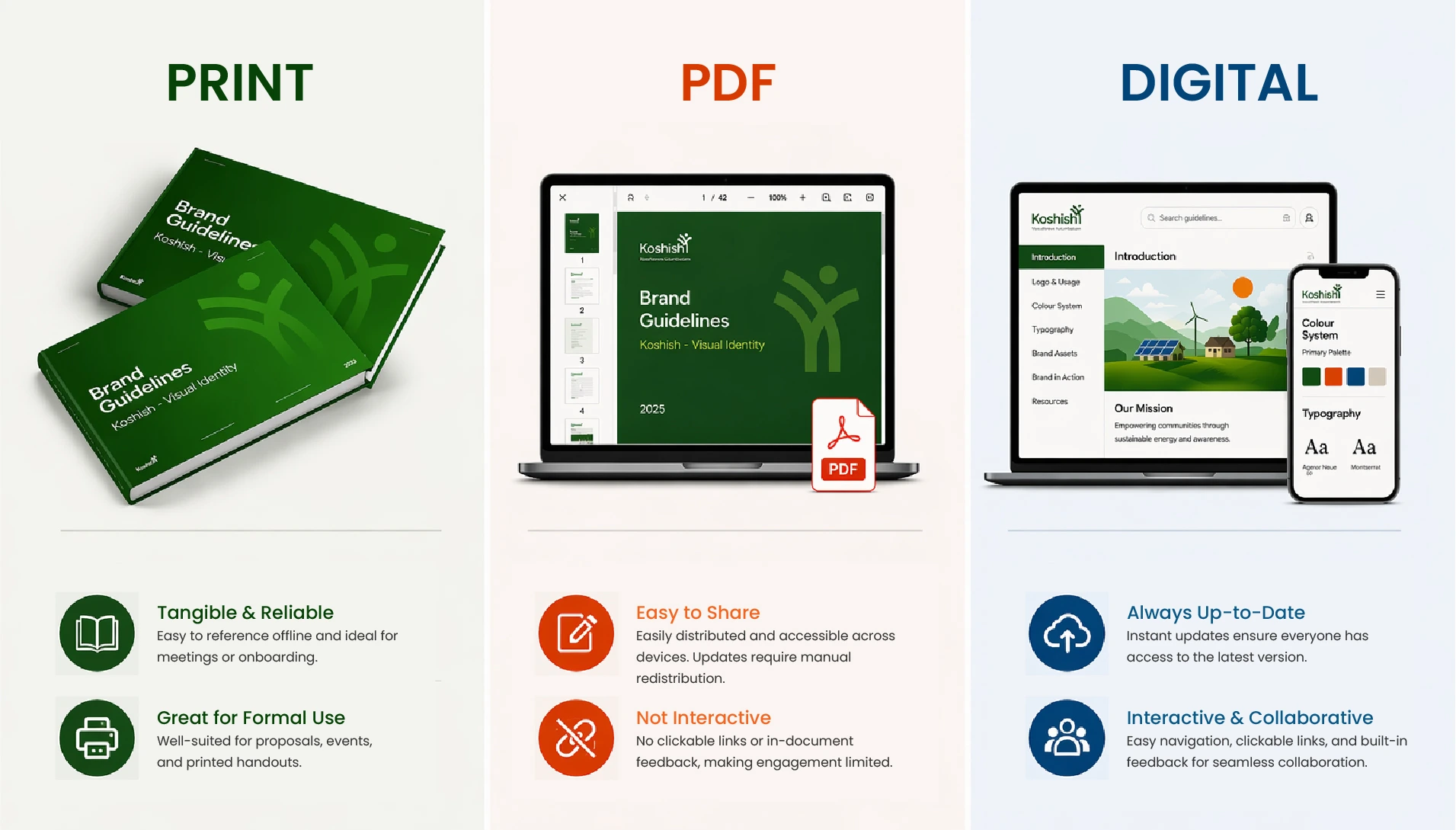
Print Guidelines
In print format, brand guidelines are the physical, hard copy of your brand rules. What makes them special is that they are tangible. You can touch and feel them, and for that reason, several luxury or established brands prefer print brand guidelines. It adds value, a touch of premiumness, and is great to distribute during client meetings.
However, they are expensive, and in case any updation is required, further expenses in editing and printing need to be incurred. Without updation, these guidelines quickly go out of date. Moreover, these are difficult to distribute to a large number of people.
PDF Guidelines
The second format - PDF - is the most common and popular format. Compared to print guidelines, these are more cost-effective and easier to distribute and update. They can also be viewed on any device.
And while there are benefits, PDF guidelines come with their own share of limitations. These are static, quickly get outdated and are often hard to find. PDF files are not interactive, so users cannot interact with elements - for instance, they cannot click a link to reach the target destination. These also do not support feedback and comments in the document itself.
Once the PDF is created and shared, any future changes require re-editing and resharing. This means that, quite often, the older version stays in circulation and leads to inconsistency in brand presentation.
Digital Guidelines
Digital guidelines are hosted online and offer multiple benefits. These are interactive and can be instantly updated. These updates can be easily accessed by anyone, anytime (without the need for resharing), so the risk of different people using different versions is simply avoided.
Digital guidelines are more user-friendly. People using them can easily locate the information they are searching for. Collaboration becomes convenient too, as people can easily share their feedback and comments.
Drawbacks of digital guidelines include a higher initial setup cost and future maintenance costs. If designed poorly, these guidelines can result in a bad user experience. Lastly, since it is digital, the dependency on the Internet is high.
To Sum Up
Each format comes with its set of benefits and drawbacks. When deciding the format of your brand guidelines, think about your:
- Brand type (luxury, start-up, and global)
- Brand updates frequency
- Team & accessibility
- Brand budget
While the print format is associated with prestige, premium value and tradition, PDF ensures ease and practicality. The digital format is best for consistency, scalability and long-term efficiency.
Final ThoughtsBrand Guidelines: A Strategic Tool, Not Just a Document
Brand guidelines are more than simple documents; they are strategic tools in reality. They help present your brand with clarity and consistency, no matter who is working on it. They ensure your brand delivers a cohesive experience and builds recognition and trust.
As a brand, therefore, you must focus on creating strong and well-defined brand guidelines.
Your Brand Deserves Guidelines That Keep It Consistent Everywhere.
Let's build a brand that looks, sounds, and feels consistent everywhere.