What Rebranding Actually Is

Before anything, let's clear the most expensive misconception in marketing:
"We got a new logo and updated the website. We rebranded."
The Misconception
No. You just resurfaced.
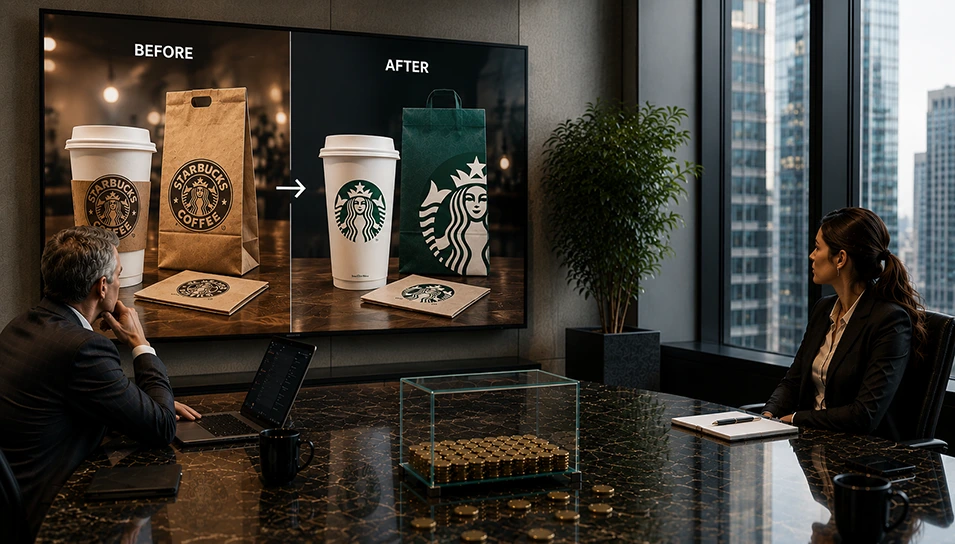
A rebrand is not a visual refresh. It's a fundamental repositioning of how your business is perceived in the minds of your customers/prospects, talent pool, investors and the market in which you are operating.
Think of your brand as the operating system running beneath your marketing, your sales conversations, your hiring, and your pricing. A rebrand upgrades the OS. A visual refresh just changes the wallpaper.
Rebranding includes:
- Repositioning your market stance (who you serve, how you're different, why you win and why customers should remember you).
- Redefining your brand voice, tone and messaging architecture.
- Redesigning visual identity to reflect the repositioned business.
- Aligning internal culture with the new brand promise.
- Communicating the change consistently across every touchpoint and different media channels.
When all five of these move together, a rebrand becomes a strategic event, not just a creative one.
02 — The ReturnsHow a Strategic Rebrand Actually Generates ROI

01. It Unlocks Price Points Your Current Brand Can't Hold
As companies evolve, their brand perception often lags behind their actual capabilities. When your brand continues to project a scrappy, early-stage image despite product maturity, buyers will naturally negotiate from that lower value tier.
Closing this perception gap through a rebrand stops the discount spiral at the root. It shifts the burden away from the sales team, removing the friction that causes prospects to question your pricing in the first place.
When Lenskart elevated its positioning from a utility-driven model to a confident, design-first brand, the inventory didn't change, but the perceived value did. The subsequent growth in premium sales proves that brand equity anchors price far better than any discount strategy, ultimately transforming marketing investments into pure margin recovery.
02. Turns Customer Into Brand Advocates
High-impact brands don't just sell features; they sell an identity. By pivoting your narrative from what you build to how it transforms the buyer's day-to-day experience, you foster a deep emotional connection. This psychological shift is what turns quiet users into vocal advocates who organically promote your business across their networks. The result: your audience moves from being passive buyers to an active community.
In the 1980s, Harley-Davidson fundamentally shifted its positioning from a mechanical hardware manufacturer to an emotional lifestyle brand. They recognised that for their audience, a motorcycle wasn't just transportation, it was an expression of personal freedom and independence.
By building an ecosystem around this shared identity, they unlocked massive loyalty and financial returns. They established dominance across diverse demographics, becoming the top seller for younger adults, women, and baby boomers alike. Furthermore, customers willingly paid top-tier prices for vehicles, apparel, and merchandise because they wanted to belong to the community.
03. It Opens Partnership Doors That Pitching Never Could
Businesses that look like serious players get treated like serious players - not just by customers, but also by partners. Distribution agreements, co-marketing opportunities, technology integrations: the gatekeeping for all of these is almost entirely brand-driven.
When Cure.fit rebranded to Cult.fit with a sharper fitness-culture identity, it accelerated conversations with brand partners, apparel companies, nutrition brands, and corporate wellness programme organisers. This was something that its earlier, more clinical identity couldn't unlock.
Partners, usually, ask one implicit question: "Will being seen with this brand help or hurt us?" A strong brand answers that before the meeting starts.
04. It Reduces What You Pay To Hire And Retain Talent
Remember the cool group of seniors when you entered college. Everybody wanted to talk to them and be a part of the group. If you became a part, you were considered cool too. That's what a brand with personality and charisma does. Talented individuals want to be a part of the brand.
When it comes to retention, here are a few simple facts.
By developing a high-equity brand, organisations can organically lower acquisition and retention costs for top-tier talent, converting market attention into strategic advocacy.
05. It Converts Your Existing Audience That Was Not Ready Before
Most businesses think of rebranding as a tool for acquiring new customers. That is half the story. The more immediate commercial return is often the audience that already knows your brand - the website visitors who did not convert, leads that went cold, and past clients who did not return. In most cases, the barrier was not your offering. It was trust. Clarity, confidence in what you stood for.
A rebrand that sharpens your message and signals genuine credibility reactivates this latent audience without a single additional rupee of paid media. Your retargeting pool, your email list, your LinkedIn followers, these people have already shown interest. A brand upgrade that gives them a clearer, more confident reason to engage turns existing awareness into revenue. That is a return on an asset you have already built and paid for.
Wondering What a Rebrand Could Unlock for Your Pricing, Partners, or Talent Pipeline?
Talk to ExpertsSo, Is It Worth It?

Every point in this article traces back to one truth: your brand is either working as a commercial asset or quietly working against you. There is no neutral.
The businesses that generate the highest return from rebranding are not the ones with the biggest budgets. They are the ones who treat it as a business decision, not a design project. They start with a clear brief, align the organisation behind it and measure what moves.
A rebrand done right does not just change how you look. It changes what you can charge, who you attract, which partners take you seriously, and how fast your team moves in the same direction.
So yes, every rupee is worth it. When the strategy is right, the timing is honest, and the execution goes all the way through.
04 — The Next StepYou've Built Something Worth Believing In. Does Your Brand Reflect That?
The rebrand is not a question of whether. It is a question of how, with whom and with what brief.
At DN Designs, we work with brands, startups, and businesses at the exact inflexion points described in this article, the moments when a business has genuinely outgrown how it presents itself to the world.
We don't start with a logo. We start with a question: What does this business need its brand to do commercially?
Then we build backwards from that answer through positioning strategy, messaging architecture, and visual identity until the brand is doing the work it should be doing.
If this article has named something your leadership team is circling, the next move is a conversation.
Book a Conversation With DN Designs.
Let's find out what your brand needs to do commercially — and build backwards from there.