

Image showing a brand communication framework connecting brand messaging, visual identity, customer experience, and audience engagement

Brand Communication: The Foundation of Every Successful Brand

Asif Anwar
June 20, 2026
Categories:Branding

Here's something most founders don't want to hear.

You don't get to choose whether your brand communicates or not. It's happening right now, with or without your input.

  • Through your pricing page.
  • Your last Instagram caption.
  • The way your support team replies to a complaint at 11 pm.

The only real choice you have is whether you're steering that conversation or just hoping it goes well.

If that last sentence made you a little uneasy, good. That's usually where the real work starts.

In This Article

What Brand Communication Actually Means

Brand communication examples showing how messaging shapes customer perception and brand positioning

Forget the textbook definition for a second.

Brand communication is just the sum of every signal your business sends - what you say, how you say it, what it looks like and whether all of that adds up to one coherent story or five conflicting ones.

It's not just about a tagline. It's not just about a logo, or your brand identity. It's also not just about "doing more content." It's the thread that ties your website copy to your customer service tone to your packaging to that one tweet that either felt like you or felt like a stranger wearing your name.

When that thread snaps, people notice even if they can't articulate why. They just feel like something's off and "something's off" is a terrible place to sell from.

Why This Quietly Decides Whether You Win or Lose

Effective brand communication builds trust, customer loyalty, differentiation, and long-term business growth

Most teams treat brand communication like a nice-to-have, something you bolt on after the product's "ready." That's backwards and it's expensive.

A few things happen when the communication is actually dialled in:

People trust you faster
Consistency reads as competence. When your brand sounds and looks the same everywhere someone encounters it, the decision to buy gets easier. There's nothing to second-guess.
You become harder to copy
Competitors can match your price. They can clone your features in a quarter. What they can't clone is a voice that's actually yours and a story that actually lands.
Loyalty stops being an accident
People don't come back for products. They come back for brands that made them feel something real. That's often the result of clear brand positioning that gives customers a reason to choose and remember you.
Your own team gets aligned without being told to
When the voice and values are clear, your support staff, your sales team, and your product folks - all start pulling in the same direction without a memo telling them to.

None of that shows up on a performance ad dashboard. But it's the difference between a business that compounds and one that just survives quarter to quarter.

The Five Things That Actually Hold a Brand Together
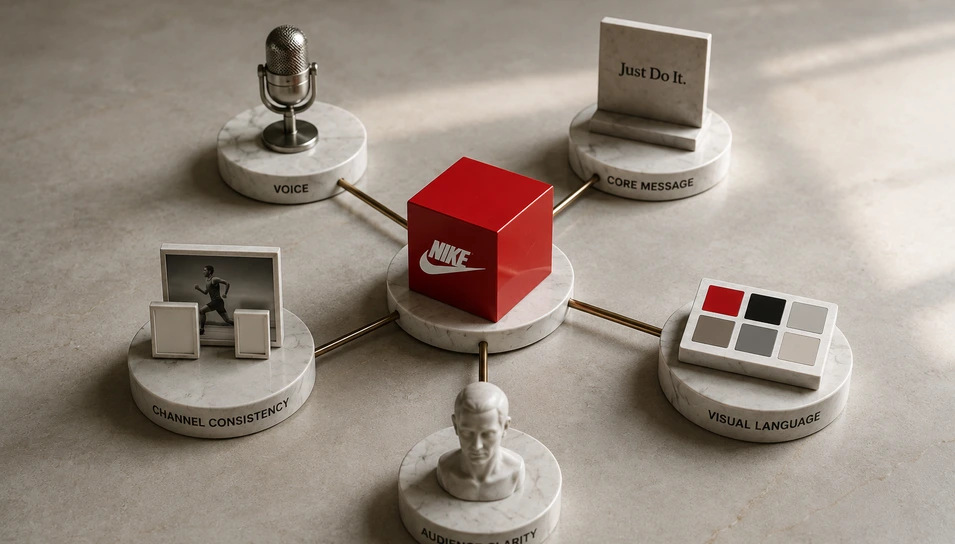
The core pillars of brand communication including voice, messaging, visual identity, audience understanding, and channel consistency

Strip away the buzzwords, and there are really only five moving parts. Get these right, and the rest follows smoothly.

1
Voice: the part of you that doesn't change
Your voice is your personality. It's the specific way you'd communicate every single time or explain your product to a friend over coffee.

Tone can flex depending on where you're showing up. Tone is how you adapt that voice to different situations (LinkedIn versus TikTok, a refund email versus a launch post). The voice underneath is always recognisably you.
2
Core Message: the one sentence that has to do the heavy lifting
If someone can't repeat what you do and why it matters in one breath, your messaging isn't working, no matter how nice the deck looks. This is the line that should survive being repeated across every ad, every landing page, every cold email, without losing its meaning.
3
Visual Language: the first impression before anyone reads a word
Your logo, your colours, your typography, these are doing work before your copy even gets a chance to. A forgettable visual identity means people scroll past you to a competitor who looks like they knew what they were doing.
4
Audience Clarity: knowing who you're actually talking to
Age and location are starting points, not strategy. The real question is what keeps your audience up at night, what they're sceptical of and what would make them trust a brand they've never heard of. Build a real picture of that person, not a demographic slide.
5
Channel Consistency: same story, different rooms
  • Show up where your audience already is, not where you assume they should be.
  • Let the tone shift with the platform, sharper and faster on Instagram, more measured on LinkedIn.
  • Remember who actually lives on each channel. Instagram skews 18-24, while Facebook skews 25-34. Talk to the room you're in.
  • Keep the core message identical everywhere, even when the delivery changes.

Not Sure if Your Brand Communication Is Actually Working?

Talk to Experts

What Happens When Brands Get This Wrong

Poor brand communication leading to lost trust, weak differentiation, expensive growth, and internal misalignment

This is the part nobody likes talking about because it's not a "creative" failure. It's a slow leak that eventually sinks the whole boat.

It usually goes in this order:

1
Trust erodes first
Say "premium" on your website and "70% off on everything" on your Instagram in the same week, and people stop believing either claim. Once a customer feels that gap, winning them back is difficult. Confusion doesn't convert.
2
Then you lose your edge
A blurry brand becomes the fallback option, not the first choice. And once you're the fallback, the only lever left to pull is price, which means your margins start bleeding before you've even noticed.

For many businesses, this is the point where a rebranding effort becomes necessary to rebuild clarity, differentiation, and relevance in the market.
3
Then growth gets expensive
Clear brands grow partly for free, through word of mouth and recall. Confused brands have to buy every single impression, every single time, because nothing's sticking on its own.
4
And finally, it eats your own team
When the story isn't clear internally, sales pitches one thing, support says another and marketing is off doing a third. Everyone's working hard. Almost none of it is compounding.

The Real-World Evidence: Two Brands, Two Very Different Outcomes

Brand communication case study demonstrating consistent messaging across digital, social, packaging, and customer touchpoints

India's market has no shortage of examples here, and they're worth sitting with.

Tata Nano
Tata Nano had genuinely smart engineering behind it, a real, affordable car built for a real need. But "the world's cheapest car" became the entire story, and "cheap" quietly became "unsafe" and "low-status" in people's heads. The positioning and communication around it were one of the major reasons for its failure in the market, and by the time that became obvious, it was too late to rewrite.
Zomato
Every reply, every push notification, every meme sounds like it came from the same witty friend who also happens to know exactly when you're hungry. That voice didn't happen by accident; it's been protected across every touchpoint for over a decade, even as the platform itself kept changing. People don't just see Zomato's marketing; they engage with it. They screenshot it and send it to friends. That's the real payoff of a brand that commits to one voice and trusts it everywhere.

Same country, same competitive pressure, two completely different results and the variable wasn't the product. It was the story being told about it.

Why Most Brands Don't Catch This Until It's Expensive

Brand communication challenges revealed through brand audits, customer perception, and marketing performance analysis

Here's the uncomfortable part: most teams are watching the wrong numbers. Clicks, impressions, and reach are all measurable, all visible on a dashboard. Brand consistency, sentiment, the gap between what you say and what people actually believe about you? Much harder to track, so it gets ignored, right up until the symptoms show up in revenue.

By then, you're not making a small fix. You're trying to rebuild trust you didn't know you'd lost.

Brand communication isn't a project with a finish line. It needs to be lived in, revisited and adjusted as your business and your market shift under you.

So What Do You Actually Do About It

The real question isn't whether this matters for your business or not. It clearly does. It's whether you're writing the story your customers tell about you or whether you're leaving that up to whoever is the loudest in your category this quarter.

If your messaging feels scattered across platforms, if your team can't agree on what your brand actually stands for or if you just know something's not landing the way it should, that's usually the moment to bring in someone who can see the gap from the outside.

That's the work we do at DN Designs. We sit down with founders and teams who are too close to their own brand to see where it's fraying and we help rebuild its voice, message, visual identity, and how it all shows up consistently across every place your audience finds you. Not a one-off deliverable, but a system that actually holds up as you scale.

If your brand has a story worth telling, it deserves to be told well and told the same way, everywhere. Let's talk about what that could look like for yours.

Your Brand Has a Story Worth Telling. Let's Make Sure It's Being Told Right.

Let's build a brand that looks, sounds, and feels consistent everywhere.