
What Is a Brand Ambassador?

A brand ambassador is a person a business partners with to represent it and promote its products or services over a period of time, in person, in advertising, online and in everyday conversations. Brand ambassadors can be celebrities, content creators, employees, customers or industry experts. They are usually compensated with a fee, free products, discounts or a commission on sales.
What sets an ambassador apart is the relationship. An ambassador isn't hired to mention a product once. They become one of the familiar faces of the brand, so their personality, values and behaviour gradually become linked to it in people's minds. That is why a branding decision sits behind every good ambassador choice.
02 · The RoleWhat Does a Brand Ambassador Do?
The exact role is set out in the agreement, but most ambassadors do some mix of the following:
- Represent the brand in person: appearing at launches, store openings, trade shows, dealer meets, campus events and community gatherings.
- Speak for the brand: in advertising, media interviews, industry panels, talks and webinars.
- Recommend it by word of mouth: to the customers, colleagues, classmates, clients or neighbours they already know.
- Create and share content: posts, videos, reviews or articles on their own channels, where they have them.
- Introduce new products: trying a launch first and sharing an honest, first-hand view.
- Answer questions and share feedback: passing on what people around them say about the brand, and giving their own input on new products.
- Drive sales, leads or sign-ups: through referrals, discount codes, event leads or affiliate programmes.
A fashion label, for example, might have its ambassador wear a new collection to an event.
A food brand might have its ambassador host a tasting at a store launch.
A software company might have a senior engineer speak about its product at an industry conference.
In each case, the ambassador represents the brand in settings that go beyond a single advertisement.
03 · TypesTypes of Brand Ambassadors
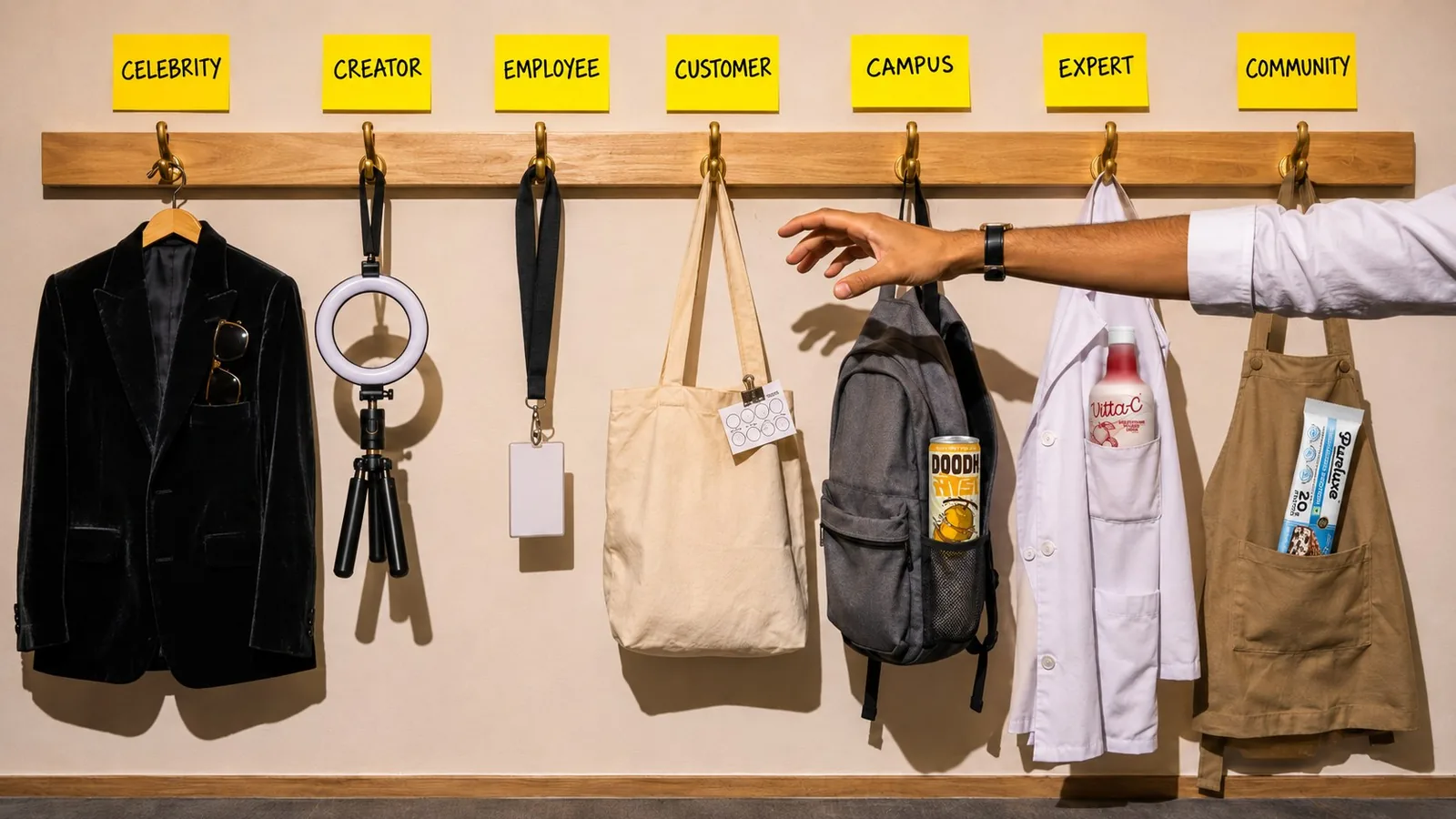
Businesses have more options than most expect, and many of them don't depend on a social media following at all. Here are the most common types.
1. Celebrity Brand Ambassadors
Actors, sportspeople and other well-known personalities who front major campaigns, appear in advertising and attend high-profile events. They bring instant reach and recognition, at a premium price.
2. Influencer and Creator Brand Ambassadors
Social media creators who work with a brand for months or years rather than for a single post, regularly featuring its products in the content their followers already watch. They range from large creators to micro and nano creators with smaller, closely engaged audiences in a niche or city, who usually cost less and suit small and local businesses. Mamaearth's early growth with mom creators is a well-known Indian example.
3. Employee Brand Ambassadors
Employees who are formally chosen and briefed to represent the company externally, at industry events, on LinkedIn, or in recruitment and product content. (More on how this differs from everyday employee advocacy below.)
4. Customer Brand Ambassadors
Loyal customers are invited into an ambassador programme, often in exchange for early access to launches, exclusive perks, discounts or a chance to feature in campaigns. Most of their influence comes through word of mouth, reviews and referrals.
5. Campus Brand Ambassadors
College students who introduce a brand to their peers by organising activities, sharing products with classmates and promoting through student groups and events. They are useful for brands targeting young consumers; Internshala's Student Partner programme, running since 2014, is a well-known Indian example.
6. Industry Expert Brand Ambassadors
Professionals whose expertise adds credibility, such as a trainer for a fitness brand, a dermatologist for a skincare range, or an architect for a building-materials company. They often represent the brand by speaking at events, writing for trade publications or recommending products to their own clients.
7. Community Brand Ambassadors
Respected local figures, such as a shop owner, a fitness-club organiser, a dealer or an active member of a residents' association, who recommend the brand within their own community. Their influence is mostly offline, and for local businesses it is often the most persuasive kind.
You don't have to pick just one. A brand might sign a celebrity for its national campaign while campus ambassadors carry the same message to students. What matters is that every ambassador fits the same brand story.
04 · ComparisonBrand Ambassador vs Influencer vs Brand Advocate vs Employee Advocate
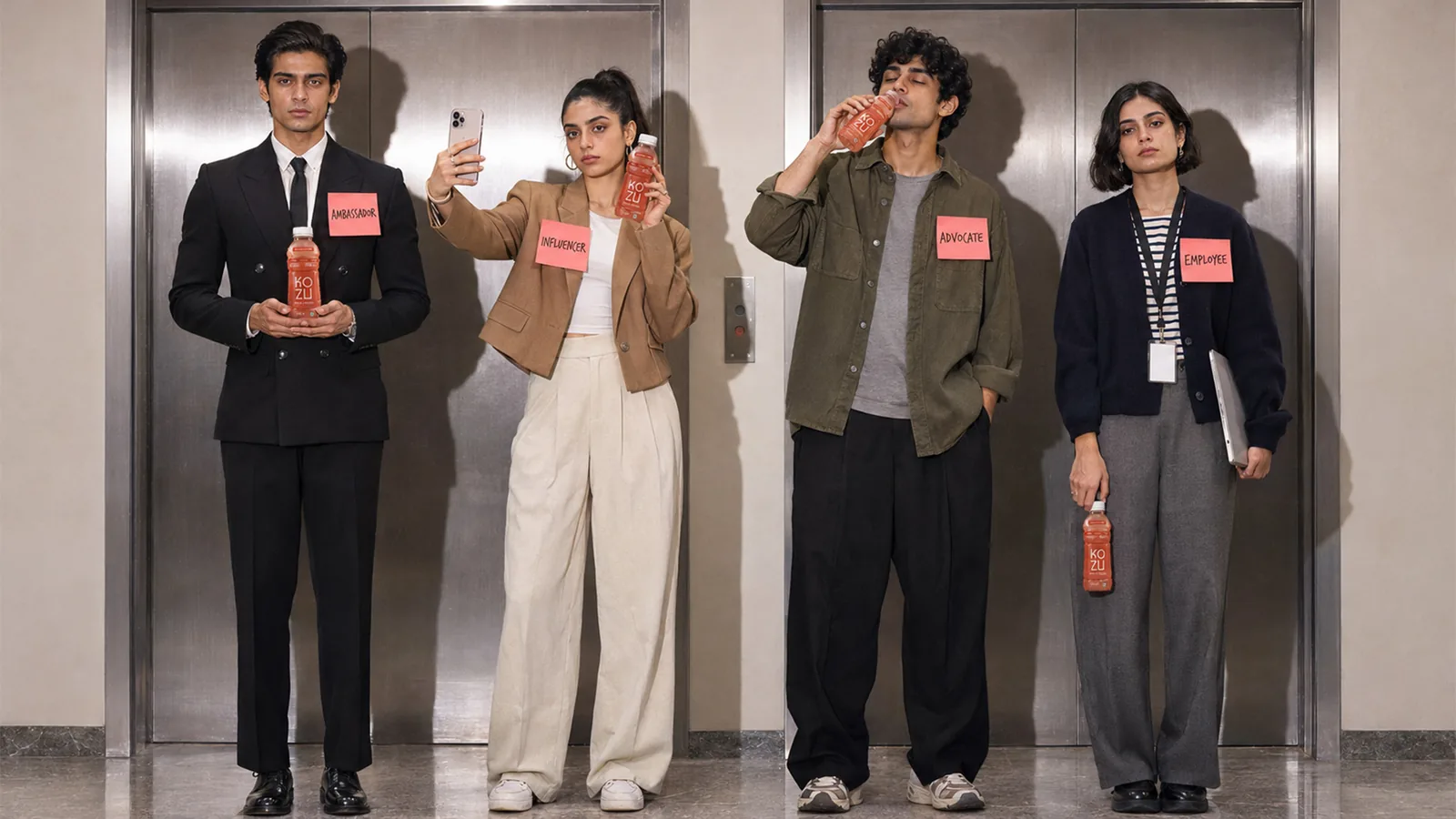
These four terms are often used interchangeably, but they describe different relationships. The difference matters because it changes what you pay, what you can control and what you have to disclose.
| Attribute | Brand ambassador | Influencer | Brand advocate | Employee advocate |
|---|---|---|---|---|
| Who they are | A chosen representative of the brand | A content creator with an audience | A genuine fan or happy customer | Someone who works for the company |
| Formal agreement? | Yes | Yes, usually per campaign | No | Usually no; sometimes part of a programme |
| How they're rewarded | Fee, products, commission or perks | Fee or free products per deliverable | Nothing; they promote because they like you | Their job, recognition, sometimes incentives |
| Typical length | Months to years | One post or one campaign | Ongoing, on their own terms | As long as they work there |
| Brand's control over message | High, guided by a brief | Medium, set per campaign | Low | Medium, guided by internal policy |
| Main value | Long-term familiarity and trust | Reach for a specific launch | Authentic word of mouth | Credibility and employer branding |
Brand ambassador vs influencer
An influencer partnership is often transactional. A creator is paid to produce a post, reel or video for a specific launch. An ambassador relationship is longer and broader, covering multiple campaigns, events and sometimes product feedback. The two can overlap: an influencer may work with a brand for years and effectively become its ambassador. In the end, the working relationship decides which one someone is, not the follower count.
Brand ambassador vs brand advocate
A brand advocate recommends your brand because they genuinely like it. There is no contract, no payment and no brief. They are the customer who tells friends about your café, or the user who defends your product in an online thread. Advocates are the most trusted voices you have precisely because nobody asked them to speak. You can't control what they say, but you can encourage them by making it easy to share, by recognising them, and by giving them a great experience to talk about. Many of the best ambassadors start out as advocates.
Brand ambassador vs employee advocate
Employee advocacy is when staff share company news, products or culture on their own channels, usually voluntarily and informally. An employee brand ambassador is a step further: someone formally selected, trained and given a defined role in representing the company. Both are valuable for credibility and hiring. Either way, if employees promote the company's products, their posts should make the employment relationship clear.
05 · BenefitsWhy Businesses Work With Brand Ambassadors

1. Building familiarity faster
A new business, or a new product, starts with no recognition. An ambassador introduces it to an audience that already trusts them, which shortens the time it takes for people to notice, remember and try it.
2. Reaching people your ads don't
Some audiences scroll past ads or don't see them at all. A college student talking about a product on campus, or a well-known shopkeeper recommending a product to regulars, or an engineer vouching for a tool at an industry meet, can reach people a paid campaign would miss.
3. Turning features into first-hand experience
An ad can list features and a price. An ambassador can show how the product fits into real life and answer the questions customers actually ask before buying.
4. Creating material the brand can reuse
Ambassadors give you testimonials, photos, videos, talks and case studies. With the correct usage rights in the agreement, that material can be reused on your website, in sales presentations, in ads and in emails.
5. Getting honest feedback from the field
Ambassadors hear what customers, peers and followers think, both good and bad. That feedback can shape products, messaging and future campaigns.
6. Becoming a consistent face over time
Working with the same person over several campaigns builds recognition that one-off promotions can't. The longer the relationship lasts, the more strongly people link that person with the brand.
06 · Brand FoundationsBefore You Choose an Ambassador, Get Your Brand Clear
This step is the one businesses skip most often. You can't judge whether someone is a good fit for your brand until you have defined what your brand is. Before shortlisting anyone, make sure you can answer:
- What do we stand for? Your purpose and values, the things an ambassador's public behaviour must not contradict.
- Who are we trying to reach? A clear picture of your audience, so you can check whether the people a candidate influences match it.
- How do we sound? Your brand voice: playful or premium, expert or friendly.
- What do we want people to remember? Two or three key messages every ambassador should reinforce.
- How do we look? Visual guidelines for how your logo, products and colours should appear in anything an ambassador shares, wears or presents.
If these answers aren't written down, every ambassador will interpret your brand differently, and with several ambassadors that quickly turns into an inconsistent brand. Brand strategy and brand guidelines work pays off here.
07 · SelectionHow to Choose the Right Brand Ambassador
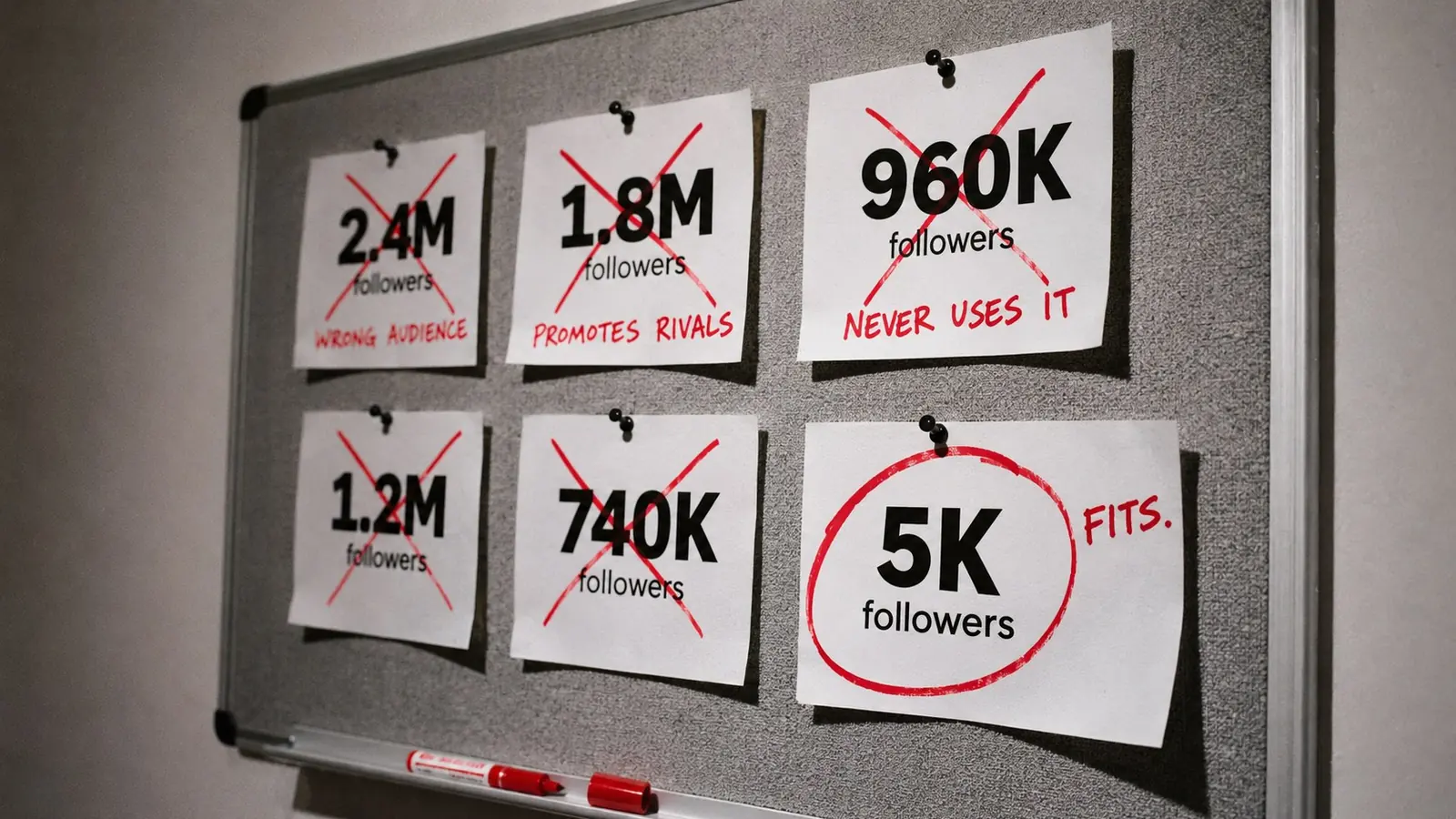
Follower count is the least useful measure, and many good ambassadors have no large following at all. Look at:
- Audience fit: Do the people they influence, whether followers, customers, colleagues, students or a local community, match your customers?
- Values fit: Does what they say and do publicly match what your brand stands for?
- Real influence: Do people act on what they say? Online, look for genuine comments and questions rather than inflated numbers. Offline, look at how respected they are in their workplace, campus, industry or neighbourhood.
- Credibility with your product: Would it make sense for them to use it? A fitness brand fronted by someone who never exercises won't convince anyone.
- Past partnerships: Have they promoted competitors recently, or so many brands that their recommendations no longer mean much?
- Communication style: Do they come across well in the settings you need, whether on camera, on stage, in a store or in a one-to-one conversation?
- Reputation: Look back through their history for anything that could become a problem later.
- Practical fit: Are they in the right city for in-person events, and available for the commitment you need?
A business opening its first retail store might need someone who can meet customers in person. A brand launching online might be better served by a creator who already talks to the right audience. Neither needs the most famous person available.
08 · Programme SetupHow to Set Up a Brand Ambassador Programme
- Set a goal. Awareness, sales, launch buzz, recruitment or community building. The goal decides who you choose and what you measure.
- Define your ideal ambassador. Use your brand values and audience profile to describe who would be a natural fit.
- Shortlist and vet candidates. Review their reputation, the people they influence and their partnership history using the criteria above.
- Agree on terms. Put deliverables, payment, duration and rights in writing (see the next section).
- Give them a brand kit. Include your brand story, key messages, tone-of-voice guidance, visual guidelines, product information, approved assets and clear do's and don'ts. A good kit keeps ambassadors on-brand without making them sound scripted.
- Launch and support. Introduce them properly, send products early, and keep a single point of contact on your side.
- Measure and review. Track results against the goal, share what's working with the ambassador, and adjust.
- Renew, grow or part ways. Strong partnerships get better with time. Weak ones should end cleanly.
What to Include in a Brand Ambassador Agreement
A clear agreement protects both sides. At a minimum, cover:
- Duration and renewal terms
- Deliverables: events, appearances, talks, store visits, posts or referral targets.
- Compensation: fee, products, commission and when it's paid.
- Exclusivity: whether they can work with competitors, and for how long.
- Content approval: whether content is reviewed before it goes live.
- Usage rights: where and for how long the brand can reuse their content.
- Disclosure requirements: how sponsored content must be labelled.
- Conduct (morals) clause: what happens if their behaviour damages the brand.
- Termination: how either side can end the partnership.
Risks to Plan For
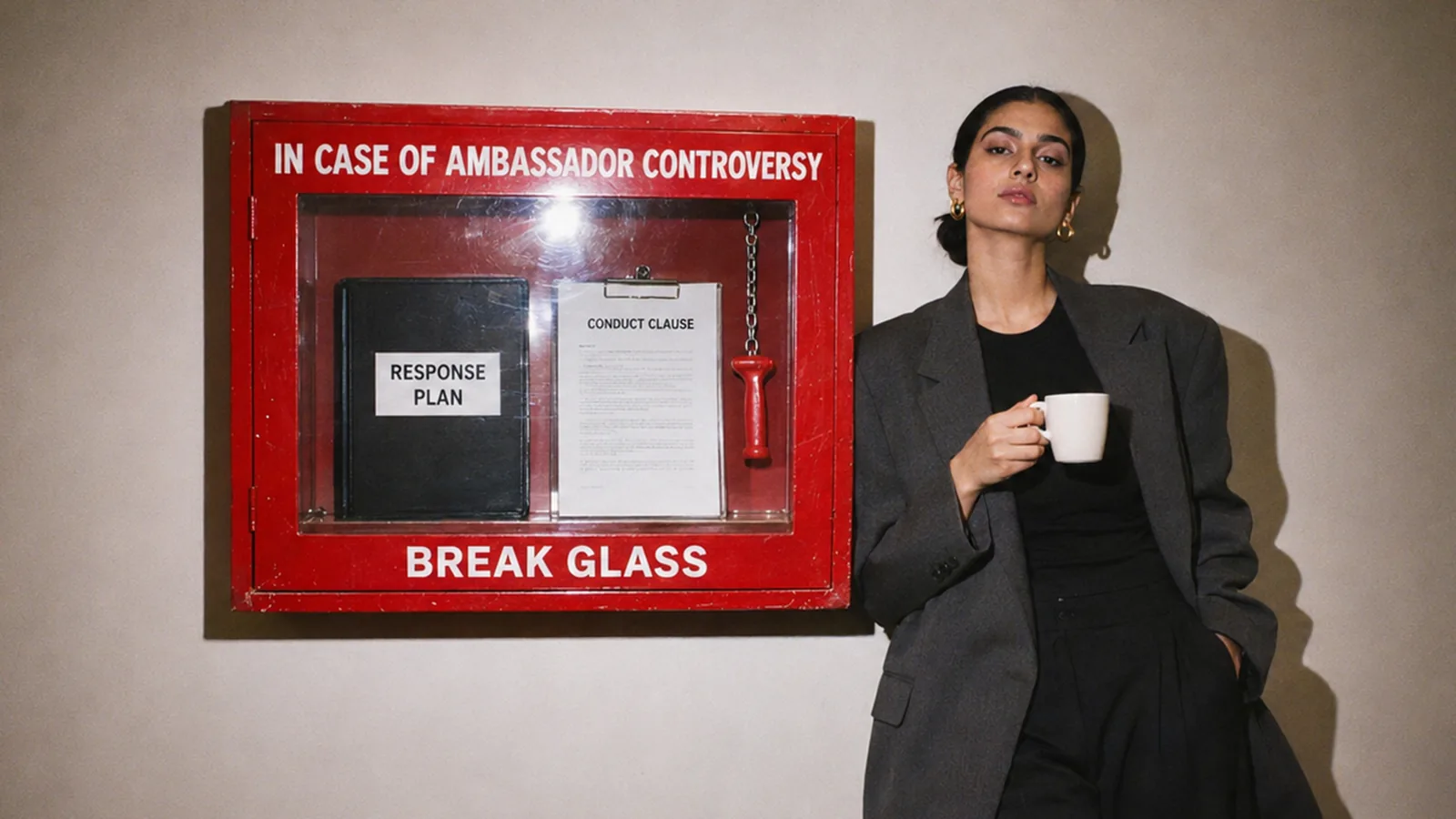
An ambassador's reputation becomes partly your brand's reputation, so plan for what could go wrong:
- Controversy: a public misstep can pull your brand into a story you didn't choose. A conduct clause and a response plan help.
- Values mismatch: an ambassador whose lifestyle contradicts your positioning confuses your audience.
- Inauthentic promotion: heavily scripted content or someone who clearly doesn't use the product damages trust.
- Over-dependence: if one person is your brand, losing them hurts. Spreading the role across several ambassadors reduces the risk.
- Non-compliance: undisclosed paid content can lead to complaints and regulatory action.
Disclosure Rules for Brand Ambassadors in India

In India, the Advertising Standards Council of India (ASCI) released its Guidelines for Influencer Advertising in Digital Media in 2021. Promotional posts must carry a clear disclosure label such as Advertisement, Ad, Sponsored, Collaboration, Partnership, Employee or Free gift. Influencers are responsible for adding the disclosure, but the brand is responsible for making sure the content follows ASCI's code, and it should ask the influencer to correct a post if needed.
Separately, the Central Consumer Protection Authority (CCPA) notified its Guidelines for Prevention of Misleading Advertisements and Endorsements for Misleading Advertisements in June 2022. These also cover celebrity and other endorsements.
In practice, any ambassador who is paid, gifted products or employed by the brand should disclose the relationship clearly, and the brand should build that requirement into its brief and agreement.
Check the latest version of these guidelines before launching a programme, as they are updated from time to time. The ASCI guidelines focus on digital media, but the same honesty is good practice offline: if someone is paid to recommend your brand, the people they recommend it to should know.
12 · ExamplesExamples of Successful Brand Ambassador Partnerships
A celebrity appearing in an ad is one thing. Having their name become closely tied to a brand is another. Here are examples from India and around the world, each showing a different approach.
1. Shah Rukh Khan and Hyundai
Shah Rukh Khan has been associated with Hyundai in India since the launch of the Santro in 1998. Rather than signing him for a single campaign, Hyundai kept working with him as it introduced more models, and he became one of the most recognisable faces of the brand in India. It is a clear example of long-term consistency building familiarity.
Sources: Storyboard18
2. Amitabh Bachchan and Cadbury Dairy Milk
In October 2003, weeks before Diwali, reports of worms in some Dairy Milk bars hit Cadbury's sales and reputation in India. Cadbury fixed the problem first: it introduced improved packaging and ran Project Vishwas, an education drive aimed at retailers and consumers. It then signed Amitabh Bachchan as its brand ambassador. One ad showed him visiting a Cadbury plant, inspecting its processes and then eating a bar. About a year later, Cadbury said sales were back to pre-controversy levels.
The lesson: an ambassador's credibility can help rebuild trust, but only when it backs up real action. The packaging changes came first, and Bachchan gave people a trusted reason to believe in them.
Sources: Business Standard, BW Businessworld
3. boAt and Its Roster of Ambassadors
boAt built its youth-focused audio brand around a roster of faces rather than one. The roster has included cricketers such as Hardik Pandya, KL Rahul and Shikhar Dhawan, and film stars such as Kartik Aaryan and Kiara Advani. Later, it added cricketer Jemimah Rodrigues, reported as the first female sportsperson signed by a brand in its category. At one point, the brand described introducing a fresh face with a fresh campaign every few months.
The lesson: several ambassadors can keep a brand current with a young, trend-driven audience, as long as they all fit one clear brand personality.
Sources: afaqs!, Indian Television
4. Mamaearth and Mom Creators
Mamaearth's early growth is widely credited to mom bloggers and parenting creators rather than celebrities. These creators had smaller, closely engaged audiences and showed how they used the brand's baby-care and skincare products at home. As the brand grew, it added bigger names, including actor Shilpa Shetty.
The lesson: in a category where trust matters most, relatable voices that reach the right audience can matter more than sheer reach. They are also within a small business's budget.
Sources: Storyboard18, YourStory
5. Internshala's Student Partner Programme
Internshala launched its Student Partner programme in February 2014, after its founder held off for years over concerns that campus ambassador programmes rarely gave students a meaningful experience. Selected college students represent Internshala on their campuses: they promote its internships and training, run sessions and compete in contests for rewards, while building marketing and communication skills of their own.
The lesson: a campus ambassador programme works best when the role offers students real value, not just targets.
Sources: Internshala blog
6. Michael Jordan and Nike
Nike signed Michael Jordan in 1984, and the first Air Jordan shoe followed in 1985. The line quickly found fans well beyond basketball, among sneaker collectors and streetwear buyers. In 1997, it grew into Jordan Brand, a separate division within Nike. Here, the partnership went beyond advertising: the ambassador became a brand in his own right.
Sources: Sports Illustrated
7. George Clooney and Nespresso
George Clooney has appeared in Nespresso campaigns since 2006. The ads use humour and his familiar screen persona while keeping the coffee at the centre. Unlike the Nike example, this partnership has largely lived in advertising, and his consistent presence has given the brand a recognisable identity in its commercials for years.
Sources: Fortune, Nespresso via Newswire
8. Audrey Hepburn and Tiffany & Co.: Brand Association Without an Ambassador
Not every powerful brand association is an ambassadorship. In the opening scene of the 1961 film Breakfast at Tiffany's, Hepburn's character, Holly Golightly, eats breakfast outside the Tiffany window on Fifth Avenue. Hepburn was never Tiffany's official ambassador, yet the film linked her with the jewellery house for generations. It shows how strongly a person can shape the way people see a brand, and why choosing who represents you deserves careful thought.
Sources: Museum of the City of New York
What these examples tell us
There isn't one formula. Hyundai and Nespresso built recognition through one familiar face over many years. Cadbury used Amitabh Bachchan's credibility to rebuild trust after a crisis. boAt used a roster of cricketers and film stars to stay relevant to young buyers. Mamaearth and Internshala showed that everyday creators and students can be powerful ambassadors on a much smaller budget. Nike built a product line, and eventually a separate brand, around its ambassador, and Tiffany's association came through culture rather than a contract. What they all share is fit: each person made sense for the brand and the audience it wanted to reach.
13 · MeasurementHow to Measure the Success of a Brand Ambassador Partnership

What you measure depends on the goal you set at the start.
| Goal | What to track |
|---|---|
| Sales | Orders from unique discount codes or referral links, UTM-tagged traffic, cost per acquisition |
| Leads and enquiries | Enquiries, demo requests and leads from events, talks and referrals the ambassador is part of |
| In-person activity | Footfall on event days, event attendance, sign-ups collected at stalls or campus drives |
| Online engagement | Engagement rate, saves, shares, comments and the sentiment in them |
| Awareness | Reach, website visits, media mentions |
| Brand strength | Growth in branded search volume, share of voice in your category, brand recall or brand lift surveys |
| Reusable material | Testimonials, photos, videos and case studies gathered, and how they perform in your own channels |
| Employer brand | For employee ambassadors: job applications, referrals and engagement with employer content |
A few examples of how this looks in practice:
- A clothing brand gives its ambassador a unique link and tracks which pieces sell through it. If one linen shirt sells out after a post, it compares those sales with its usual weekly figures.
- A café invites its regulars to become ambassadors and gives each one referral cards. It counts the cards redeemed against its usual weekday breakfast orders.
- A B2B software company sends two senior engineers to speak at industry events and tracks the demo requests that come from leads collected there.
- A skincare brand working with dermatologists asks new customers how they heard about it, and tracks how many say a doctor recommended it.
One caution: a spike after a post or an event doesn't automatically mean the ambassador caused it. Compare against a baseline period, and look at several weeks rather than a single day.
14 · ConclusionConclusion: Finding the Right Face for Your Brand
A brand ambassador can be a celebrity launching a new car, a creator wearing a label's latest collection, an employee speaking at an industry event, or a loyal customer recommending you to friends. Whoever you choose, the partnership works best when the person genuinely fits your brand and your audience, and when your brand is clear enough for them to represent it consistently.
At DN Designs, we help businesses build the foundation that makes ambassador partnerships work: brand strategy and positioning, brand guidelines and ambassador brand kits, and ambassador and influencer programmes that connect your brand with the right voices, online and offline. If you're planning an ambassador programme, talk to our team about getting your brand ready for it.
Frequently Asked Questions
Do brand ambassadors get paid?
Usually, yes, though not always in cash. Ambassadors may receive a fixed fee, free products, discounts, commission on sales, or a mix. Customer and campus ambassadors are often rewarded with perks and experiences rather than money.
How long does a brand ambassador partnership last?
There's no fixed duration. Some run for a single launch, but most are agreed for six months to a year, with the option to renew. The most successful ones often last for years.
Can small businesses benefit from brand ambassadors?
Yes. Small businesses don't need big names. A loyal customer, a respected local figure, a well-connected employee or a local creator can deliver strong results at a fraction of the cost.
Does a brand ambassador need a large social media following?
No. Many effective ambassadors, such as employees, loyal customers, industry experts and community figures, have little or no online following. What matters is whether the people they influence are the people you want to reach. Even online, a creator with 5,000 engaged local followers can be worth more to a neighbourhood business than one with 500,000 followers spread across the country.
Can an employee be a brand ambassador?
Yes. Employees make credible ambassadors because they know the product and the company well. If they promote the company's products, they should make it clear that they work there.
Do brand ambassadors have to disclose the partnership?
Yes. In India, ASCI guidelines require paid, gifted or employee promotions on digital media to carry a clear disclosure label such as Ad, Sponsored, Collaboration or Employee.
Does DN Designs help with brand ambassador and influencer programmes?
Yes. DN Designs helps businesses with the brand strategy and brand guidelines that keep every ambassador on-brand, and runs influencer marketing campaigns for brands working with content creators.